
Photo Gallery

|
|
Photo Gallery |
|
|
Panoramas |
|
| SX 55359 74644* (GPS 58min) | North Row 182m, South Row 264m. |
| Visits - June 2000 | No magnetic anomalies (Only circle stones tested). |
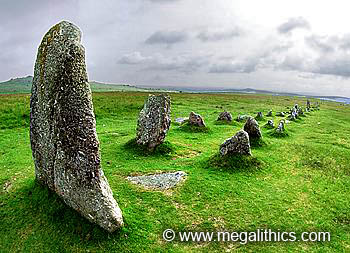
This area of the Merrivale site is
dominated by two double stone rows. Although the rows are only about 1m wide and
most of the stones making them up are small, both rows are over 150m long. The
rows appear to run parallel to each other, but measurement reveals that they
diverge towards the west by about 2 degrees.
The northern row is the shorter of the two and is about 180m long, but although it still
has its eastern terminal "blocking" stone, there is no sign of the
western terminal stones, so the row just peters out and it may have
originally been longer.
The southern row has both sets of terminal stones intact, and its 264m length is
therefore probably the original measurement. This row is unusual in that
it has stone circle standing almost in the middle of its length. The circle is
small, we measured a diameter of 3.7m with 6 stones standing, all less than 0.5m
in height, another 3 - 4 lie fallen. At the centre of the circle are the remains
of a small cairn or barrow. We could not discover if the cairn and circle were
built with the row, or were the result of reuse of the site in later times.
About 14m south of the eastern section of the south row is a large cist, the massive
capstone of which was originally 2m long, unfortunately in 1860 the stone was
split to make a gatepost, so today two pieces remain, both showing the drill
holes made by the mason for his splitting wedges. The slab lined rectangular
cist is now easily accessible due the
missing section of capstone, and it is now popular with the local sheep as a convenient shelter from the moorland wind.
About 40m west of the central stone circle in the south row another single row
runs away to the SSW, this row is about 40m long and its few remaining stones
are difficult to pick out, the most prominent standing where it passes the
remains of a small cairn. A second, much larger cairn lies about 30m west of the
small cairn and row.
As mentioned above, most of the
stones that make up the rows are small, but we noticed that important areas such
as the row termini were marked by much larger stones, we also noticed that
larger stones were occasionally inserted along the length of the south row.
Taking a closer look at these larger stones we noticed that in they seemed to
mark positions in the row opposite some of the monuments external to the row.
There is a very large stone on the south side of the row opposite the eastern terminus
of the northern row, another very large stone stands on the south side of the
row opposite the site of the large cist, at the western end, two smaller
stones mark the position of the single stone row and cairn, and another large
stone, again on the southern side of the row, marks the larger cairn. We do not
think that these large stone placements could be coincidence, and if they were
part of the original row, then the monuments that they mark must be the same
age, or older.
*Centre of the stone circle in the southern row.
|
|